


Howah, what a year!
The “too long, didn’t read” version of this post is: we pulled off several successful projects locally and in North Dakota and Wisconsin. We were so honored to be invited to assist tribes, tribal members, schools and private landowners in overcoming barriers and getting hundreds of plant relatives in the ground. The community-building aspect of this work leaves us in awe. We got dirty with everyone from seasoned gardening pros to Native American youth who had never planted a seed in the ground before. We want to thank every volunteer, and especially all the project team members who took time to care for our plant relatives throughout the season. We see your dedication, your passion for learning how this place really works, and your willingness to enter into a reciprocal relationship with the land beneath your feet. Gichii Miigwech!
2025 Activities Summary
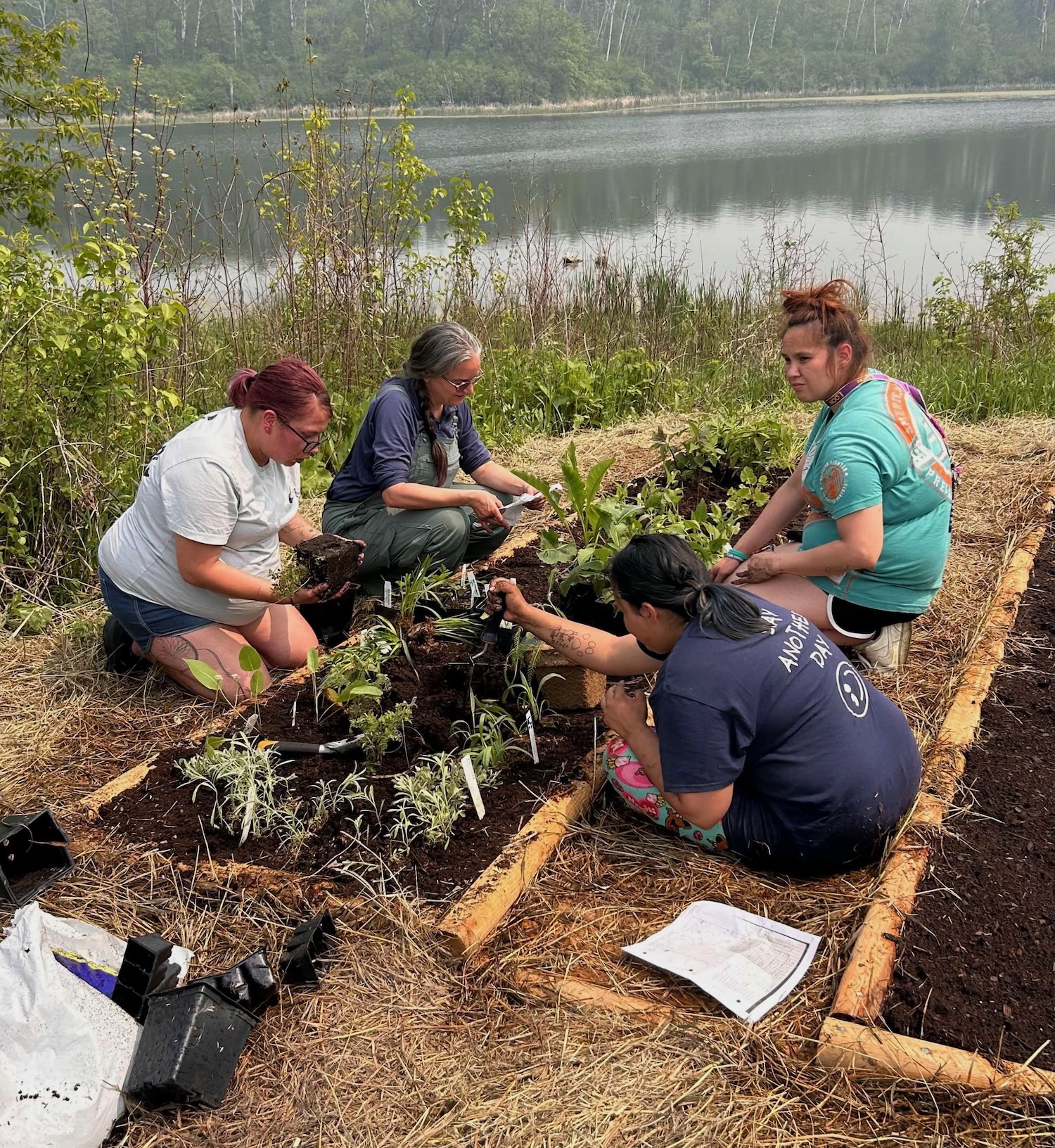
- Turtle Mountain Projects. In February of 2025, we visited the Turtle Mountain Band of Chippewa (Belcourt, North Dakota) to discuss various potential projects and partnerships. We traveled to Turtle Mountain again in May of 2025 and installed two separate gardens at an elder educator’s-one for medicinal plants, and one for annual vegetable crops (over 100 plants and shrubs). After spending some more time with various elders, we were invited to consult on the restoration of land around the tribal Heritage Center. That work has been ongoing, including another site visit in October and the presentation of a three-year plan to create a mid-height prairie ecosystem around the Heritage Center. Funding and grading work did not come through before winter. We plan to continue to help with the Heritage Center restoration project into 2026 and beyond, as well as visiting to help maintain and potentially expand the demonstration garden effort to support hands-on youth education.
- School-based Demonstration Gardens. Continued our partnership with the American Indian Education team at Robbinsdale Public Schools to create Indigenous food and medicine gardens and educational programming. In late May, we worked with the FAIR Crystal (middle school) Native Education team and volunteers to plant over 35 new live species (sourced from nurseries, seedlings started at Migiziwazison, and live plants from Migiziwazison nursery plots). Repaired and extended the drip irrigation conversion system (from sprinkler head)–construction work at the school prevented us from getting the automatic watering working for the entire season (volunteers hand watered). This school may be closed or turned into an elementary school and we will need to work with a different set of Native Education team members to continue the project. We also provided consultation, training (held at Migiziwazison) and plants for another school-based “healing garden” group at a public school in Plymouth. In early June we provided live plants and seeds to the team.
- Red Cliff Band Project, Wisconsin. Create a demonstration “food forest” with two purposes: First, to demonstrate Migiziwazison’s capabilities and commitment, building a relationship that will support potential future projects. Second, to support the a family’s care for a severely disabled child with diabetes. They wanted to provide fresh and dried fruit instead of candy for the times when they need to raise this child’s blood sugar; however, in that area, fresh and dried fruit is both hard to come by and is very expensive. Given the amount of time needed to care for this child, spending days in the bush to go berry-picking is impossible. In early June, Migiziwazison agreed to bring approximately 40 fruit and nut-bearing young shrubs and trees, and with a volunteer, spent the day planting them around the property. Several berry-giving relatives, surprisingly, produced fruit this first season.
- Group Events/Training: Throughout the growing season, Migiziwazison hosted various groups and conducted talks/training as educational outreach. Groups included: a Girl Scouts troop from Saint Paul, the ZLE team (Plymouth school garden), two families that bid on tickets to an afternoon plant walk and dinner as a fundraiser for the Center For Irish Music, educators and other staff from the Washington County Watershed District, graduate Landscape Architecture students and two professors from that University of Minnesota program. We also conducted a training for the Vadnais Heights Green Team and will be supporting their Food Forest Project (more information available via this local news article).
- Private Land Consultations/Restoration support. We began offering free consultations to private landowners nearby (conducted one in Grant about 4 miles from Migiziwazison), and conducted three projects on private land. Two of those projects involved planting, re-planting or caring for existing native species on land adjacent to Migiziwazison. One involved planning the removal of lawn on a regular lot in Saint Paul, and providing about 20 live plants and many seeds to the landowner as well as continuing consultation/advice, resulting in a very successful first year of growth and natural re-seeding of about 1/3 of their former front lawn.
- Online Outreach. We are notoriously bad at keeping the website current–the blog feature is time-consuming & finicky to utilize. We had many conversations about how or even if we wanted to use the blog, or social media, to provide knowledge to those we will never be able to meet in person. Anakwad Migizi/Wendy is particularly uncomfortable with the idea of a regular social media presence–because social media is about personalities, not knowledge transfer, and she has no interest in that kind of personal attention from strangers. Her Anishinaabe teachings also stress the importance of building real relationships and doing knowledge transfer in hands-on situations—directly in opposition to how social media works. However, Migiziwazison has a relationship with the East Metro Water District Educator, Angie Hong, who runs a social media account (@mn_natureawesomeness on Instagram). On two occasions, we have hosted Angie and helped provide content around non-chemical methods to remove invasive species such as buckthorn and asian bittersweet.
- Internship: U of M Landscape Architecture Program Partnership & “The Granary” Renovation. After doing student training and several meetings with professors from this program, Migiziwazison created an internship job description and submitted it for student consideration (for the 2026 season). In order to provide housing, in addition to hourly pay for the intern, we added 12 feet onto the newly moved granary and have made significant progress in creating toilet, shower, and work space facilities in the addition. We had a heat pump installed so there is much more efficient heat in cool weather, and air conditioning (necessary for the comfort of the intern in summer). We will be adding a kitchen in the original space and doing other renovations to make this a fully functional tiny house.
- eBook: Anakwad/Wendy authored a “Gifts of Our Plant Relatives” ebook that focuses on the food and medicinal properties of common native species in this region. The goal of this ebook is to get people excited about the benefits of land restoration, beyond the noble ideals of supporting pollinators and wildlife. The medicines described in the ebook are ones that are simple, reasonably safe (in terms of plant identification and potential overdose) involving only very plentiful plants, and don’t lend themselves to commercialization. Currently, the draft of the eBook is being edited and will eventually be made available on our website.
Other Activities:
- In late March, we asked the maple trees if they were well enough to support us taking some sap for our annual sugarbush. And this year they said yes! We had an excellent sugarbush, hosting some friends to teach them how to process syrup themselves. We made several gallons of maple vinegar, and distributed bottles and education on this important food/medicine to various recipients.
- Cleared more buckthorn, invasive honeysuckle, and Asiatic Bittersweet. Figured out that recycled billboard vinyl tarps are precisely what is needed to smother out large areas of vegetation (using the cover-uncover-mow-cover-uncover-mow-cover-replant method). Replanted the area previously covered by the BAT (big-area-tarp) with a mix of tall and mid-height shade tolerant prairie grasses and forbs, as well as Prairie Moon’s new “Battle the Buckthorn” mix (designed to out-compete buckthorn with faster-growing grasses in the first few years after planting). East Metro Water filmed some of this work for their “mn_natureawesomeness” Instagram account.
- Continued work to mitigate the Mountain Pine Beetle infestation and replant in new clearings. Discovered that the ONLY place that responded to replanting (didn’t get out-competed by bittersweet and buckthorn) was where the slake pile was burned when we took the infected trees down. From now on, we will be taking the time to create a serious controlled burn (in order to eliminate the buckthorn and bittersweet seed load in the soil) in every new clearing before planting with shade-tolerant species. For the first time, we have several new species successfully growing in the woods, such as Yellow Giant Hyssop, Hairy Wood Mint, Tall American Bellflower, and various penstemon and lobelia species.
- Planted approximately 100 saplings on Migiziwazison and neighboring properties.
- Harvested seeds (wild, heirloom and bred here) and roots and re-distributed them. Seeds include vegetables and native plants used for food and medicinal purposes.
- Planted over 40 native shrubs and perennials, and sowed thousands of native seeds (purchased and harvested) on Migiziwazison and neighboring properties.
- In the experimental gardens, successfully grew the 5th generation of a flint corn cross, despite having to re-plant after a late spring flood of the lower garden. For the first time, we used mesh cloth as pest deterrent for young tomatoes and cucumbers successfully. It was a very rainy season, so the harvest was affected by fungal issues and too much moisture, but we did enjoy a lot of fresh vegetables and were able to freeze and can some extras. Created a red wine cap mushroom bed near the old ice house ruins and harvested approximately 50 pounds of mushrooms from it. Established a new raised bed on the east end of the barn (old tank-turned-horse trough) and successfully grew several different plants that have usually had severe pest issues by deploying mesh until late in the season.
- Continued to use Barred Rock hens to clear areas of vegetation in preparation for re-planting. Areas from the first year are THRIVING with planted indigenous grasses (specifically a “home base” of Blue Grama near the hops lines that can be used for plug and seed distribution).
- Planted several new species in the nursery plots around the Nest area. All but two survived. Collected seeds from these new neighbors and will propagate seedlings for re-introduction elsewhere. Several of these plants kept in the “nursery” plots have medicinal qualities, and provided decent harvests this first year as well.
- Continued traditional Anishinaabe medicine gathering and processing work; distributed the medicines to elders and other knowledge keepers, and shared sweetgrass and sage with Native Education colleagues.